
Transitions: What works and why?

When we talk about transitions in adoption, we mean the period when a child moves from their foster family to their adoptive family, adjusting to new caregivers, a new home, a new school, an unfamiliar area, and a range of new people who will all play a part in their life.
Transitions can evoke a mixture of feelings for everyone who is involved, a move for a child into their growing up home can represent a new chapter beginning. It can be full of hope, excitement and for most adoptive families the goal is in sight following the ending of the adoption approval assessment process.
Some of our children are waiting for their adoptive families, and so for them there can be a sense of relief that this is now really happening.
However, alongside these positive emotions can also come feelings that can make us feel nervous, worried and or scared about the change and the unknown. It is important that everyone recognises that these feelings are normal, and a healthy part of transitions.
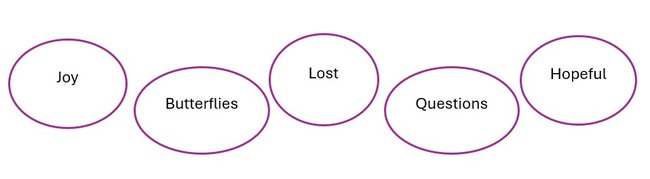
Some words prepared by children and young people in foster carer in Buckinghamshire, 2025.
Maggie, a skilled foster carer writes about her experience:
"There are nerves, excitement, trepidation and a deep need for us to execute the dance expertly for the sake of the child which makes it an onerous task which, once completed, is utterly rewarding and bittersweet."
Bittersweet for the foster carer as they are no longer the main carer for the child but rewarding as they have moved to their growing up home and the foster family will still continue to hear about how they are progressing so the child knows those important people have not disappeared.
How we support the adults
Transitions will be spoken about all through the adoption assessment process, and your social worker will help you to think about how you can prepare emotionally and also practically for a child who may join your home.
We offer a family and friends meeting with your network once you are linked with a child to think with them all about the child who is coming to live with you, what you may need from your network during this time and how and when it is best to introduce new people into the child’s life. We can talk about a range of ways which they can be included in your child’s life in those early days such as a ‘WhatsApp group’ to share updates and photos.
We know that peer support is so important, and the best people to understand how you may be feeling are those that have also gone through the process, we will link you up with other adoptive families for support and twice a year we hold a social event so you can continue to meet other families.
Direct work with children
"Young children, and babies in particular, are unlikely to have the tools or the confidence to express the extent of their loss, during or after the move. It is our task to be emotionally attuned and responsive to complex emotions they will be experiencing and provide them with an environment that allows space and time for feelings of excitement and hope, but also for painful feelings of loss and mourning"
Boswell and Cudmore (2013)
For older children (often from 3 yrs) we have various ways of working with children, their foster carers and alongside nurseries and schools. We use various books such as ‘Dennis Duckling’ and ‘Dennis and the Big Decisions’, to try and help children make sense of the decisions that are being made about their life.
We would then think with children about different types of families and use resources such as Usborne ‘All about families book’ to help children make sense of how families may come together. All the time trying to help children recognise their own feelings and giving them the space to be able to share these if they can.
Various resources can be used with children when thinking about transitions and staying in touch with special people after a move, such as the story book ‘The Invisible String’.
The visual use of toys during play can be used to help a child understand that even if you are not in the same house, that people do not just disappear.
Transitional items
We ask all of our families to prepare a transitional book all about themselves and their home to be shared with a child before the move starts. Alongside this we ask for you to purchase a soft toy for the child, who will be linked into the transitional book and you.
Foster carers will ask for photos of you which they can put up around their home and also will want you to make some short video clips of singing or reading a book which they can share with the child.
We will help you when you are linked with a child to prepare these items in a way which will best meet the needs of the child who will be joining your home.
Moving to Adoption, University of East Anglia
Buckinghamshire Council follow the principles as set out in the UEA (University of East Anglia) Moving to Adoption Model. You can find further information about the model here.
5 Top Tips from Maggie for a good transition
- We must be genuinely child focused and hold the child in mind throughout the process of a transition.
- Make sure that the preplanning is carefully thought about, tailor the plans to each individual child, foster family and adoptive family.
- There needs to be flexibility, opportunities for people to share their views and be heard. Plans may need to be tweaked or changed to ensure that everyone is comfortable at each stage.
- Professionals must encourage the formation of an authentic relationship between the adoptive family and the foster carers which demonstrate empathy, understanding and consideration of the other party's needs and feelings.
- My family have seen the benefit of promoting the ongoing presence of the foster family in the child’s life, in whatever way it is best for all parties going forward.
To summarise
Transitions can be complicated, there are a lot of individuals involved, each have their own thoughts, feelings and experiences.
It takes time for children to settle into a new home and feel safe. Whilst there may be tough times, there are also many amazing moments along the journey, such as the first time your child goes to sleep in their new home, or the excitement when a milestone is reached in front of you.
We will be there with you each step of the way and continue to think creatively about how we can support your family to navigate your new normal together.
Speak to us
If you'd like to talk to us about transitions or ready to start your adoption journey, get in touch.